
Kemp

INSIGHT

The PISCES Market: A Comparable Overview

BY Victoria Younghusband
19 Jan 2026
The Private Intermittent Securities and Capital Exchange System (PISCES) represents a landmark shift in the UK’s financial markets landscape. Operating within an FCA regulatory sandbox, it allows private companies to have their shares traded on a secondary market intermittently – providing liquidity for shareholders without the full regulatory burden of a public listing. As of December 2025, two firms have been approved to run PISCES platforms: the London Stock Exchange (LSE) and JP Jenkins. While both operate under the same FCA "PISCES Sourcebook" rules, they offer distinct models tailored to different company needs. As of early January 2026, neither platform has launched, likely because any company applying for its shares to be traded will have to obtain shareholder approval and undertake restructuring, including dematerialising its shares to enable them to be traded electronically.

Key Differences: LSE vs. JP Jenkins

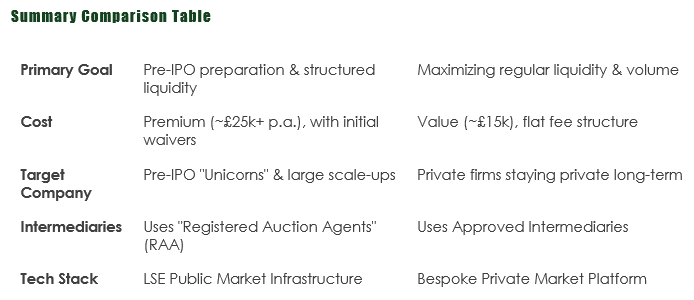
The primary distinction lies in their trading mechanisms and strategic positioning. The LSE positions its venue as a premium "stepping stone" to public markets, while JP Jenkins focuses on maximizing liquidity through more frequent trading windows.

1. Trading Model & Frequency

LSE Private Securities Market (PSM): 

  • Mechanism: Operates on an auction-based model. Companies can schedule specific "auction events" (e.g.one-off, semi-annually or quarterly).
  • Philosophy: Designed to be structured and event-driven, similar to a capital raise or a tender offer, allowing companies to concentrate liquidity into a specific timeframe.
  • Frequency: Timing agreed with the LSE.  Typically less frequent (e.g. 2-3 times a year).

JP Jenkins PISCES Venue: 

  • Mechanism: Offers a choice of "Continuous Trading Blocks" (instead of a single auction day, these provide longer windows (up to 5 consecutive business days every month) where orders can be placed and matched continuously) or a monthly auction. 
  • Philosophy: Aims to minimize the "administration-heavy" nature of auctions and provide something closer to a regular secondary market experience.
  • Frequency: Higher frequency, targeting companies that want regular monthly liquidity for shareholders.

2. Cost Structure

LSE PSM: 

  • Fees: Positioned at a premium price point (approx. £25,000 for two auctions/year, with additional auctions costing extra).  
  • Incentives: Known to offer fee waivers (e.g., free first year) to attract high-profile scale-ups.

JP Jenkins: 

  • Fees: Generally lower cost (estimate approx. £15,000 total), positioning itself as the value option for a broader range of private companies.

3. Strategic Positioning & Target Audience

LSE PSM:

  • Target: Large scale-ups, "unicorns" and companies explicitly preparing for an eventual IPO.
  • Brand Value: Offers the prestige of the LSE brand. Being on the PSM is seen as a signal of maturity and a logical step before moving to the Main Market or AIM.
  • Infrastructure: Leverages the LSE’s existing public market technology and "Disclosure Portal", including an “Investor Q&A” facility, offering a familiar environment for institutional investors.

JP Jenkins PISCES Venue: 

  • Target: Established private companies that may wish to stay private indefinitely but need a solution for employee/early investor liquidity that is broader than the matched bargain facility and potentially open to companies incorporated overseas.
  • Brand Value: Capitalizes on its long history of matching trades for unlisted companies. Focused as a pragmatic, liquidity-first solution rather than a stepping stone to the public markets.
  • Infrastructure: Generally limited to trading facilities with company disclosures forwarded to Approved Intermediaries.

Regulatory Context for Both Platforms

Regardless of the platform, both operate under the Government’s 2025 PISCES regulations and the FCA’s sandbox PISCES sourcebook, which means:

  • Stamp Duty Exemption: Transfers on both venues are exempt from Stamp Duty/SDRT.
  • Maintenance of tax advantaged employee incentives: companies can amend existing (or establish new) Enterprise Management Incentives (EMI) and Company Share Option Plan (CSOP) to include a sale on a PISCES platform as an exercisable event.
  • Investor Restrictions: Access is limited to institutional and to “qualifying individuals”, that is sophisticated individual investors (including self-certified high net worth individuals), and, on a PISCES company by company basis, employees, consultants and advisers to the PISCES company concerned. Intermediaries must ensure that retail investors have strict "buyer beware" warnings. Companies may be able to exclude access to disclosures where they can demonstrate that this is necessary to protect their legitimate commercial interests.
  • No Capital Raising: Neither venue can be used by PISCES companies to raise new capital (primary issuance) or to buy-back their shares; they are strictly for secondary trading by of existing shares by existing shareholders and eligible new investors.